
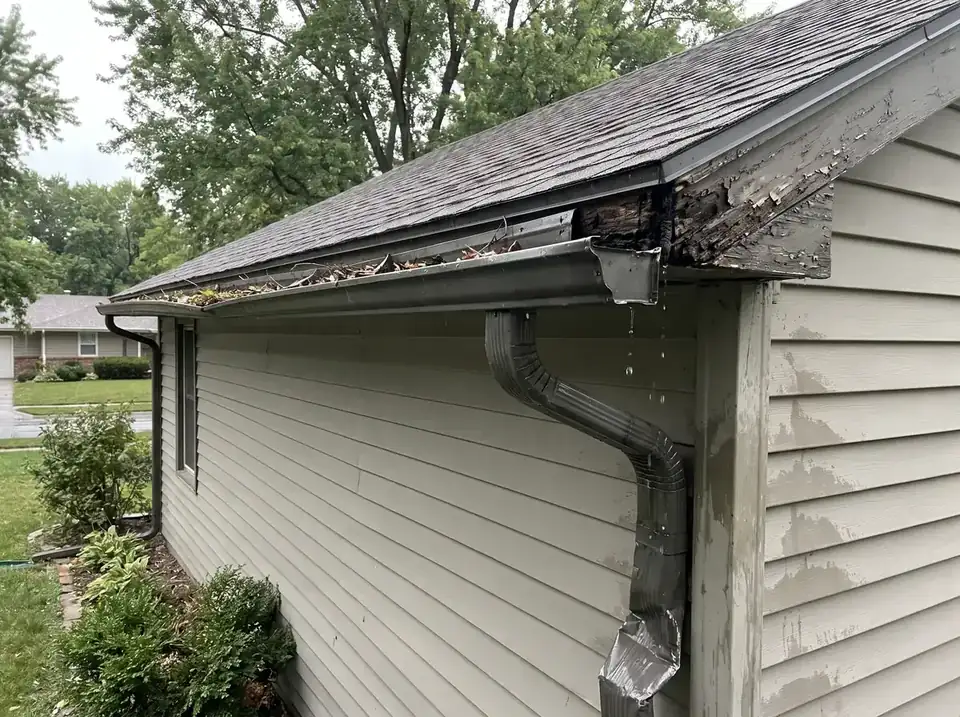
Why fascia rots behind gutters
| Source | How water reaches the wood |
|---|---|
| Missing drip edge | Water runs behind the gutter |
| Clogged gutter | Water spills over the back |
| Gutter pulled away | A gap opens |
| Leaking corner | Steady drip on one spot |
| Peeling paint | Bare wood soaks up water |
| Hail | Damaged paint and dented trim |
In Mesquite, strong sun and summer heat over 100°F break down paint quickly, and the heavy storms of spring and fall find the bare wood.
How fascia is repaired
- Take down the gutter along the damaged run.
- Probe the wood to find where rot stops.
- Cut out bad boards and check rafter tails.
- Replace with primed lumber or rot-resistant trim.
- Repair the soffit and clear vents.
- Add a drip edge.
- Prime and paint or wrap.
- Rehang the gutter on hidden hangers.
Fascia on Mesquite houses
On brick ranches, the fascia is often a narrow painted board above the brick line, sometimes wrapped in aluminum. Rot shows up most at corners, at the ends of runs, and below valleys. On newer houses with composite trim, the issue is more often gaps and caulk than rot.
Pests
Gaps in rotten fascia and soffit let in wasps, birds and squirrels. Replacing the wood closes them.
Why fascia rots in Mesquite
Fascia is the board the gutter hangs on. It rots when water gets behind the gutter: from overflow at a clog, from a missing drip edge, from a gutter pulled away, or from leaking corners. Mesquite's heat dries wood fast between storms, but repeated wetting at the same spot still softens it over the years.
What a repair looks like
- Take the gutter down.
- Probe the fascia; mark soft areas.
- Cut out and replace soft boards, and check the rafter tails behind.
- Prime and paint, or wrap in aluminum.
- Fit drip edge if needed.
- Re-hang the gutter.
Pricing
Fascia repair is usually priced per board or per foot once the gutters are off, because the extent is not known in advance. Ask how it will be priced before work starts.
Soffit
Soffit is the underside of the eave. Water stains or sagging soffit often mean water has been getting behind the gutter for a while.